How to Find Where Your Strategy Leaks
Most strategies don't fail in the chain of command. They fail in the handoffs between teams. Here's a 20-minute exercise to find yours before your goals lock.
When I first read Donald Sull's research on strategy execution, one finding took me straight back to my corporate days.
84% of managers said they could rely on their own boss and their own team all or most of the time. Only 9% said they could always rely on colleagues in other departments.
Strategies Leak Sideways
Most planning is built top-down. The company sets priorities. Departments turn them into department goals. Teams turn those into team goals. Each level checks the one above it.
That vertical chain mostly works. Donald Sull and his co-authors, Rebecca Homkes and Charles Sull, surveyed managers across hundreds of companies and found that commitments up and down the hierarchy were generally kept.
The handoffs between teams were different. Commitments from another department were barely more reliable than promises from an outside supplier. When managers can't count on other teams, they protect themselves. They duplicate work, delay their own deliverables, or pass on opportunities they'd need help to seize.
Each choice makes sense locally. Added up, it's expensive. In 2005, Michael Mankins and Richard Steele found that companies deliver, on average, about 63% of the financial performance their strategies promise. A good share of the missing 37% leaks out through these gaps.
It's Rarely Personal
I've worked in and alongside a lot of organizations with great cultures where people still work in silos. It's rarely territorial or malicious. In my experience it comes down to two things.
The first is trust, or simply busyness. When everyone is stretched, teams share less with each other than they should.
The second is safety. It feels safer to stay in your own lane and focus on what you alone can control. Nobody wants to be accountable for a goal that depended on someone else.
Early in my career, I was more or less at war with our marketing department. I felt they never took the time to understand my team's business. Eventually I gave up, and we found other ways to compensate.
It wasn't personal. We actually liked them. They had different priorities, and looking back, we probably didn't make it easy for them either.
What I only saw later was that nobody had set up any mutual accountability. They had their measures, we had ours, and the two didn't fit together. They weren't evaluated on our success, and we couldn't change that on our own.
Why It Starts in Planning
That kind of gap is built in during the planning cycle. Look at almost any set of annual goals and you'll find hidden dependencies. Marketing's launch goal depends on product shipping on time. Sales' revenue target depends on a hire HR hasn't budgeted for. Operations' cost target depends on a system IT hasn't scheduled.
None of that is written in the plan. It lives in people's heads and meeting notes. So nobody owns it, and nobody chases it until it's late.
Each team needs to know what the others are aiming for from the very beginning, and plan around it. That's why planning shouldn't be a box-ticking exercise. If nobody owns the process, and teams never talk about how their measures connect, the strategy rarely reaches its potential.
A 20-Minute Exercise Before Your Goals Lock
You don't need software for this. You need one short session per team, while plans are still open.
1. List the goals you can't hit alone. Ask each team lead to go through their draft goals and mark every one that depends on another team. Most leads find two or three. Some find more than they expected.
2. Write the dependency down. Next to each one, note which team, what exactly you need from them, and by when. "Support from IT" isn't enough. "Customer data export from IT by the end of February" is.
3. Send the request now. Not in month four, when it's urgent. Send it while the other team is still writing its own goals, so they can plan for it.
4. Treat silence as a risk. Any request nobody accepts is a gap in your strategy. Put those on the leadership agenda before goals lock. It's a ten-minute conversation now, or a missed target in September.
5. Review the handoffs, not just the goals. In quarterly reviews, add one question: which cross-team commitments are at risk? It's often the most useful question in the meeting.
After the Plan Is Set: Reward Mutual Success
The exercise gets the dependencies into the plan. What keeps them there is how people are rewarded once planning is over.
Think back to my marketing story. Neither team was measured on the other's success, so neither of us had much reason to try. That's the part I'd fix first now.
Tie part of the bonus to shared goals. A slice of each team's bonus can depend on the cross-team goals it supports, not only on its own.
Celebrate the joint wins. When a result took two teams to land, recognize both, publicly and by name.
Mix the teams. Team-building, offsites and morale boosters do more when they bring departments together than when each team celebrates on its own.
None of this needs to be big. It just needs to say clearly that helping another team succeed counts.
Somebody to Lean On
There's a 1988 Travelling Wilburys song, Handle with Care, with a line about having somebody to lean on. I always misremembered it as needing somebody to lean on. Honestly, I think my version is the better lesson for business: every team needs another team it can count on.
The exercise above is a small way to build that in. When it's done well, the plan usually gets smaller and more honest, because some goals turn out to depend on work nobody had agreed to do. And the conversations between teams start earlier and stay calmer, because nobody gets surprised in month four.
It's simple, but in my experience it rarely happens. Most planning processes, and most planning tools, are built around the vertical chain. They make the cascade easy and the sideways links invisible. That's why we let one team ask another for support inside the plan when we designed KITA Planning. But a spreadsheet and a calendar invite will get you a long way.
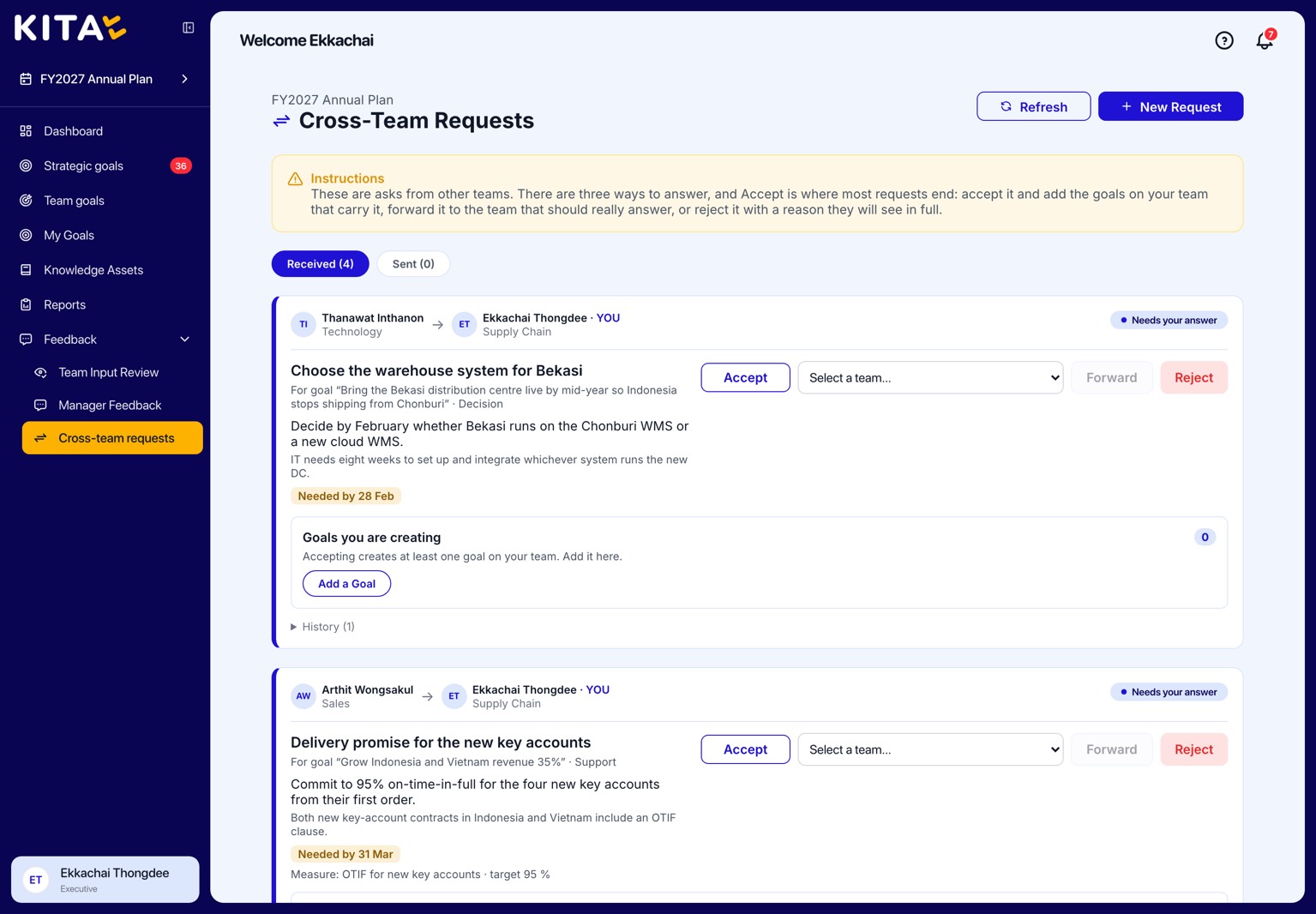
In KITA Planning, one team sends a request and the other accepts, forwards or rejects it with a reason. Sample data.
Where has your strategy leaked: inside teams, or between them?
Sources
Donald Sull, Rebecca Homkes and Charles Sull, "Why Strategy Execution Unravels, and What to Do About It," Harvard Business Review, March 2015. Michael Mankins and Richard Steele, "Turning Great Strategy into Great Performance," Harvard Business Review, July 2005.